## Evaporation from soil surface
The **maximum amount of evaporation from the soil surface** equals the maximum evaporation from a shaded soil surface, $ES_{max} [mm]$, which is computed as:
$$
ES_{max} = ES0 \cdot e^{(\frac{- \kappa_{gb} \cdot LAI} {\Delta t})}
$$
where $ES0$ is the potential evaporation rate from bare soil surface $[\frac{mm}{day}]$. The **actual evaporation from the soil** mainly depends on the amount of soil moisture near the soil surface: evaporation decreases as the topsoil is drying. In the model this is simulated using a reduction factor which is a function of the number of days since the last rain storm (Stroosnijder, 1987, 1982):
$$
ES_a = ES_{max } \cdot (\sqrt{D_{slr}} - \sqrt{D_{slr} - 1} )
$$
The variable $D_{slr}$ represents the number of days since the last rain event. Its value increases over time.
If the amount of water that is available for infiltration ($W_{av}$) is below a critical threshold, $D_{slr}$ increases by an amount of $\Delta t [days]$ for each time step.
$D_{slr}$ is reset to 1 if the critical amount of water is exceeded.
In the LISFLOOD settings file this critical amount is currently expressed as an *intensity* $[\frac{mm}{day}]$. This is because the equation was originally designed for a daily time step only. Because the current implementation will likely lead to *DSLR* being reset too frequently, the exact formulation may change in future versions (e.g. by keeping track of the accumulated available water of the last 24 hours).
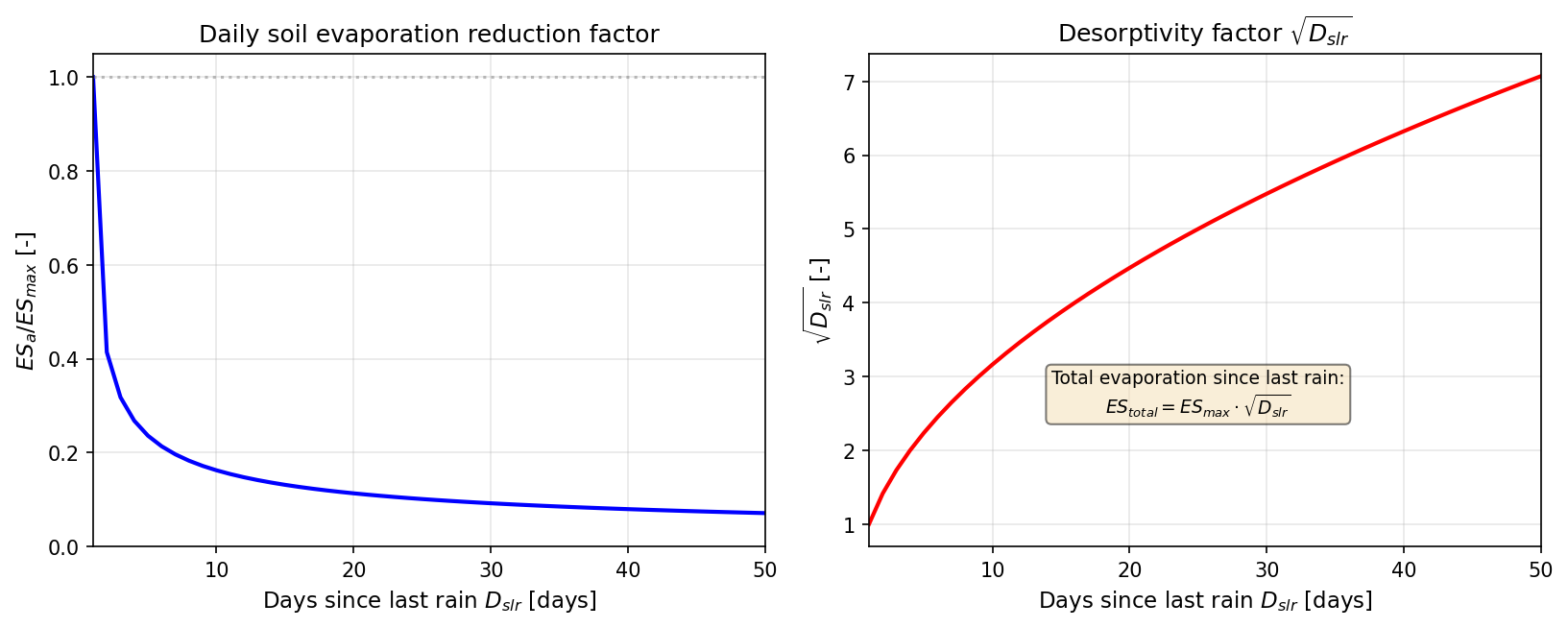 ***Figure:*** *Left: daily soil evaporation reduction factor as a function of days since last rain ($D_{slr}$). Right: cumulative evaporation follows a square-root-of-time relationship.*
The **actual soil evaporation** is always the smallest value out of the result of the equation above and the available amount of moisture in the soil, i.e.:
$$
ES_a = \min (ES_a,w_{1t} - w_{res1t})
$$
where $w_{1t} [mm]$ is the amount of moisture in the superficial and upper soil layer and $w_{res1t} [mm]$ is the residual amount of soil moisture in the combined layer. Like transpiration, direct evaporation from the soil is set to zero if the soil is frozen (i.e. when the [frost index F](../2_05_stdLISFLOOD_frost-index/) is above the critical threshold value).
The actual soil evaporation is extracted from the superficial soil layer ($ES_{a,1}$) and, subsequently, from the upper soil layer ($ES_{a,2}$):
***Figure:*** *Left: daily soil evaporation reduction factor as a function of days since last rain ($D_{slr}$). Right: cumulative evaporation follows a square-root-of-time relationship.*
The **actual soil evaporation** is always the smallest value out of the result of the equation above and the available amount of moisture in the soil, i.e.:
$$
ES_a = \min (ES_a,w_{1t} - w_{res1t})
$$
where $w_{1t} [mm]$ is the amount of moisture in the superficial and upper soil layer and $w_{res1t} [mm]$ is the residual amount of soil moisture in the combined layer. Like transpiration, direct evaporation from the soil is set to zero if the soil is frozen (i.e. when the [frost index F](../2_05_stdLISFLOOD_frost-index/) is above the critical threshold value).
The actual soil evaporation is extracted from the superficial soil layer ($ES_{a,1}$) and, subsequently, from the upper soil layer ($ES_{a,2}$):
$ES_{a,1} = \min ([w_{1} - w_{res1}] , ES_a)$
$ES_{a,2} = \max ([ES_a-ES_{a,1}], 0)$
The amount of moisture in the superficial and upper soil layers is then updated as follows:
$w_{1} = w_{1} - ES_{a,1}$
$w_{2} = w_{2} - ES_{a,2}$
$w_{1t} = w_{1} + w_{2}$
[🔝](#top)